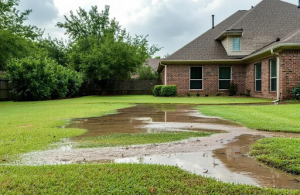
A puddle in the lawn and water running toward a patio may look like the same problem, but they rarely share the same fix. One might trace back to compacted soil. Another might come from grading, a downspout, irrigation runoff, or a low point pulling water from the whole yard. Installing a drain before you know the source can just move the problem somewhere else, sometimes into a part of the property that was dry before.
This guide walks through 13 yard drainage solutions, what each one actually addresses, and how to decide whether your property needs grading, a surface drain, a French drain, better soil, or some combination of the four. Most backyard drainage issues trace back to a handful of root causes, so matching the fix to the cause matters more than installing whatever’s most familiar or whatever a neighbor happened to install last year.
What Causes Yard Drainage Problems?
Most yard drainage problems come down to four things: too much water reaching one spot, water that can’t soak into compacted or clay-heavy soil, land that sends water the wrong direction because of grading, or an exit path that’s blocked or undersized. Most properties have more than one of these working against them at once, which is why the same puddle can survive several attempted fixes.
- Puddles that keep returning to the same place.
- Muddy soil that stays soft longer than the rest of the yard.
- Erosion channels, exposed roots, or washed-out mulch.
- Water collecting next to a structure or retaining wall.
Any of these point to a specific cause, not just general “bad drainage,” which is exactly why matching the symptom to the right fix matters more than reaching for a popular product first. Guessing at a solution tends to be more expensive in the long run than taking the time to trace the water back to its source.
13 Ways to Improve Yard Drainage
Not every yard needs all 13 approaches. Beyond the five most common fixes covered in depth below, a handful of other drainage solutions are worth knowing about depending on the property:
- Swales that guide surface water along a shaped, shallow channel across a sloped lawn.
- Channel drains that collect runoff along a wide patio or driveway edge instead of one isolated point.
- Permeable paving that lets water filter through the surface instead of running off it.
- A rain garden that slows and absorbs runoff through a shallow bed of water-tolerant planting.
- Correcting irrigation runoff and overwatering , which causes plenty of wet spots that have nothing to do with rain.
- Fixing an isolated low spot created by settling, which is different from regrading the whole site.
- Keeping existing drains and gutters clear of leaves and debris after storms.
- Managing slope and retaining-wall drainage where erosion or wall movement starts to show up.
The five solutions below come up the most often, and each one solves a different kind of problem, so it’s worth confirming which one actually fits before you commit to it.
Improve Soil Drainage
If water falls where it should but soaks in too slowly, the soil itself is the bottleneck, usually from compaction or clay content. This is one of the most common landscape drainage issues, and working organic matter into planting beds helps in many cases, though severe hardpan needs a different approach. Soil improvement fixes slow infiltration. It won’t stop water that’s being directed there by bad grading.
Redirect Downspouts
Sometimes the yard isn’t the real problem, the roof is. A modest patch of landscape can end up absorbing runoff collected from an entire roofline. Check where the downspout actually empties, whether it dumps beside the foundation, and whether the receiving area already ponds before adding any other water drainage solutions.
Add Proper Landscape Grading
Sometimes the issue isn’t a missing drain. It’s that gravity is working against the property. Subtle grade changes near a foundation, patio edge, or planting bed can send water toward the house instead of away from it. Grading is one of the more overlooked landscape drainage solutions precisely because requirements vary by site, so there’s no universal slope number that works everywhere.

Install French Drains
French drains give water trapped in saturated soil an underground path out, using a perforated pipe and gravel trench that lets water move to an outlet instead of sitting where it fell. They’re not designed to solve every kind of standing water. A single surface low point, a blocked existing drain, or a downspout dumping straight into one spot usually needs a different fix first, since a French drain addresses subsurface saturation rather than surface pooling.
Use Catch Basins
Think of this as collect first, convey second. A catch basin makes sense where surface water naturally converges at a low point, like a lawn depression or the low corner of a patio, and needs to enter a pipe to get somewhere useful. But a basin without a proper discharge route just collects water. It doesn’t solve where that water ultimately goes, which is the part homeowners tend to overlook.
How to Choose the Right Yard Drain
The right yard drain depends on whether water is moving across the surface, saturating the soil beneath it, collecting at one low point, or crossing a wide hardscape edge. A single drain isn’t a complete drainage system unless the water it collects has somewhere safe to go, which is worth confirming before any installation begins.
| Drainage Situation | Option to Evaluate |
| Water collects at one low point. | Catch basin or area drain |
| Soil stays saturated. | French drain |
| Water crosses a driveway or patio. | Channel drain |
| Surface runoff follows a slope. | Swale or grading |
| Roof runoff causes pooling. | Downspout redirection |
| Hardscape creates excess runoff. | Permeable paving |
More than one of these situations often applies to the same property, which is why a mixed approach is common rather than a single fix handling everything.
Best Drainage Solutions for Different Yard Problems
The table below maps common complaints to the factor worth investigating first, and the fix that tends to follow from it.
| Yard Problem | Likely Factor | Potential Solution |
| Standing water in the lawn | Low spot or poor infiltration | Soil improvement, grading, catch basin |
| Constantly soggy soil | Compaction or subsurface water | Soil improvement, French drain |
| Water beside the house | Roof runoff or grading | Downspout redirection, grading |
| Water flowing down a slope | Terrain runoff | Swale, grading |
| Patio or driveway flooding | Hardscape runoff | Channel drain |
| Wet area near retaining wall | Inadequate wall drainage | Retaining-wall drainage |
When to Hire a Professional for Drainage Installation
Some of these fixes are weekend projects. Others aren’t.
- Water repeatedly collects near the house.
- The issue involves a retaining wall or a slope.
- Regrading or an unclear discharge route is involved.
- Runoff is crossing onto a neighboring property.
- Previous drainage work hasn’t solved the problem.
Search interest in drainage installation San Diego tends to spike right after storm season, but the work itself should start with evaluating grading and soil preparation, along with runoff sources , not picking a drain product off a list.
A drainage problem should be traced before it’s treated. Standing water doesn’t automatically mean a French drain is the answer, it could be grading, a downspout, compacted soil, overwatering, or a hardscape edge sending runoff somewhere it shouldn’t go. If water keeps returning to the same area, the useful next step is understanding where it enters the property, how it moves across the site, and where it can safely go. California Landscape Development can evaluate grading, soil, hardscape, and existing drainage before recommending a system built for your property rather than a generic one pulled off a shelf.
Frequently Asked Questions
What are the best yard drainage solutions for standing water?
It depends on why the water is standing. A low spot needs grading or a catch basin, while slow infiltration usually calls for soil work or a French drain.
How do I know if my yard has a drainage problem?
Watch for pooling that keeps returning to the same spot, erosion, soggy soil, or washed-out mulch after normal rainfall, not just after an unusually heavy storm.
What type of yard drain is best for my property?
Catch basins collect surface water at a point, French drains manage subsurface water, and channel drains handle runoff crossing a hardscape edge. The right pick depends on your site.
How can I prevent water from pooling in my yard?
Proper grading, healthy soil that actually absorbs water, clear drains, and correctly routed downspouts prevent most pooling before it starts.
Can poor drainage damage my landscape and home?
It can contribute to erosion, saturated root zones, and hardscape settlement over time, though not every puddle signals structural damage.