A yard that looks finished at noon can feel like a different property once the sun drops. Steps blur into the lawn, a path disappears somewhere past the third planting bed, and a patio that hosted lunch an hour ago now sits in the dark, cut off from the rest of the house. That gap between how a landscape looks and how it actually functions after dark is exactly what landscape lighting is meant to close.
Done well, it gives people enough visual information to move through the yard without hesitation, keeps patios and seating areas usable once the light fades, and lets the plants, walls, and water features that took real work to design stay visible instead of vanishing at dusk. The goal is simple: see clearly, move safely, and actually enjoy the space once the light is gone.
Why Landscape Lighting Matters
Good outdoor lighting rarely gets planned as its own project. It gets bolted on after the landscaping is finished, usually with a string of solar stakes along the driveway. That’s a missed opportunity, because lighting does three distinct jobs once it’s actually part of the plan. First, it helps people read the space: where a path turns, where steps begin, where a lawn ends and a retaining wall starts. Second, it extends how the yard gets used.
A patio, a fire pit, an entrance, any of these can stay functional well past sunset instead of going dark the moment dinner ends. Third, it gives shape to the landscape itself. Trees, hedges, and garden beds that disappear into silhouette during the day take on real depth and texture once a bit of light hits them the right way. Landscape lighting, approached this way, is less about decoration. More about infrastructure.
Popular Outdoor Lighting Options
Before choosing where light goes, it helps to know what’s actually available. Not every fixture does the same job, and mixing a few types tends to work better than relying on one everywhere. Here are the main outdoor lighting ideas worth knowing before you start planning:
- Path lights: Low, ground-level fixtures that mark walking routes and planting edges without throwing light upward into anyone’s eyes.
- Step and deck lights: Built into risers or rail posts to show exactly where one level ends and another begins.
- Spotlights: Narrow, directional beams aimed at a single tree, wall, or architectural detail.
- Uplights: Ground-mounted fixtures that send light upward, good for trunks, columns, and textured stone.
- Downlights: Mounted higher up, usually in trees or eaves, casting a softer light down over a broader area.
- Wall-mounted fixtures: Fixed to the house or a structure, useful near entrances and garage doors.
- Well lights: Recessed into the ground so the fixture stays out of sight while the light does the work.
Most yards end up using three or four of these together rather than one fixture type stretched across the whole property.

Pathway and Walkway Lighting Ideas
A path doesn’t need to be lit like a runway. People need enough visual information to read its direction, its edges, and whatever’s about to change underfoot, not a wash of brightness from end to end. Good pathway lighting pays attention to where a walkway bends, where it meets a step or a slope, and where one path crosses another. Those transition points deserve more attention than a long, straight stretch of pavers. Spacing fixtures in a perfectly even row often looks stiffer than the landscape calls for. Following the natural curve of a bed, or pulling a fixture slightly off-line to sit near a plant cluster, usually reads as more intentional. Worth checking before final placement: what’s planted nearby, and how tall it’ll get. A path light tucked behind a young shrub works fine in spring and disappears completely by midsummer.
Patio and Outdoor Living Area Lighting
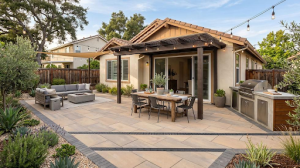
Patios don’t need one lighting plan. They need several, depending on what’s happening in each part of the space. Backyard lighting for a dining table looks different from what a lounge chair area needs, and treating them the same tends to leave one or the other either too dim or uncomfortably bright.
- Dining areas: Enough light to see the food and each other, without glare bouncing off plates or glasses.
- Conversation areas: Softer, lower-level light around seating rather than a bright overhead source.
- Outdoor kitchens: Focused task lighting over prep counters and grills, separate from ambient patio light.
- Steps and level changes: Clear definition anywhere the patio drops or rises, even by a few inches.
- Pool or raised edges: Visible boundaries wherever a drop-off could catch someone off guard.
- Routes back to the house: A visual thread connecting the patio to doors and walkways, so the transition indoors doesn’t pass through a dark patch.
Treating each zone separately, then checking how they read together, tends to work better than lighting the whole patio as one block.
How Landscape Lighting Improves Safety
Pathway lighting covers where people walk. This is about what creates risk once it’s dark, which isn’t always the same thing. An unexpected step, a retaining wall edge , uneven paving near a patio, an entrance with no light at all: these are the spots where landscape lighting does its most practical work, simply by making a hazard visible before someone finds it with their foot. It’s worth separating two ideas that often get blended together. Safety lighting helps residents and guests move through the yard without surprises. Outdoor security lighting serves a different purpose, improving visibility around entry points, side yards, and other areas that stay dark otherwise. It’s reasonable to say that better-lit access points make a property easier to see and monitor. It’s a stretch to claim lighting alone prevents anything. The honest framing is visibility, not guaranteed protection.
Accent Lighting for Plants and Landscape Features
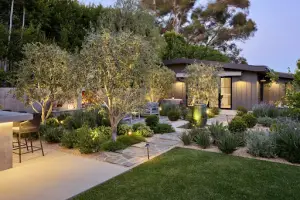
Once the practical zones are covered, the next question is what actually deserves attention. Not every plant needs its own spotlight, and treating them all equally tends to flatten the display instead of highlighting it. Good garden lighting works more like a spotlight on a stage than a floodlight over a field.
- Mature trees: A single uplight can bring out trunk shape and branching without lighting the whole canopy.
- Layered planting beds: Selective light on the tallest or front-most plants suggests depth better than lighting every row equally.
- Feature plants: One standout specimen, lit slightly brighter than what’s around it, reads as intentional rather than random.
- Water features: Enough light to catch movement or reflection, without erasing the shadow that makes water look like water.
- Sculptures or garden art: A narrow beam keeps attention on the object instead of the surrounding bed.
Leaving some areas dim on purpose isn’t a gap in the design. It’s often what makes the lit areas stand out at all.
How to Highlight Your Home and Hardscape
After the plants and water features, the built parts of the landscape deserve the same kind of attention. Exterior walls, stone textures, retaining walls, paver patios, and steps all read differently once light hits them at an angle instead of straight on. A stone wall lit from below picks up texture that gets lost in flat daylight. A pergola with light woven through the beams turns into a structure people actually notice instead of walking past. Entrances benefit from the same logic: a wall-mounted fixture near the door does more for how Choosing the Right Lighting for Your Landscape
With the options and the zones both covered, the real decision comes down to a handful of practical questions. Working through a house presents itself after dark than a bright overhead floodlight ever will. This isn’t a repeat of the plant-focused accent lighting covered earlier. Living landscape and built landscape ask for different treatment, and mixing the two into one generic conversation tends to flatten both.
these before buying a single fixture tends to save a second round of adjustments later.
- What needs to remain visible? Steps, edges, and entrances usually outrank decorative features.
- Which areas actually get used after dark? A patio used nightly deserves more planning than a side yard nobody visits.
- Where are the real risk points? Level changes and uneven paving matter more than open lawn.
- Which one or two features deserve attention? Trying to highlight everything usually highlights nothing.
- How bright are the surrounding areas already? A fixture that looks perfect in isolation can feel harsh or weak next to a neighboring light source.
- Will nearby plants grow around the fixture? A well-placed light today can be buried by August.
- Is the fixture rated for its location? Anything near irrigation, soil, or standing water needs the right rating.
- Does the finish match the surrounding hardscape? A mismatched fixture stands out for the wrong reason.
Tips for Planning a Landscape Lighting Design
The easiest way to include lighting in your landscape design is to skip the fixture catalog at first and just walk the yard after dark, flashlight in hand rather than any actual lighting turned on. Notice where footing feels uncertain, where a path seems to vanish, and where the eye naturally goes once there’s nothing but shadow. From there, the priorities tend to sort themselves into a rough order: movement zones first, since those affect safety directly, then activity zones like patios and entrances, then risk areas such as steps or drop-offs, and finally the focal features that make the landscape worth lighting in the first place. Once those priorities are clear, the harder question is how they connect. A beautifully lit patio that empties into total darkness at the property line doesn’t function as one space. It functions as two disconnected ones. Planning the whole yard as a single, coordinated composition, rather than treating the driveway, the walkway, and the patio as separate projects, is what keeps a lighting plan from feeling patched together.
Common Landscape Lighting Mistakes to Avoid
A handful of mistakes show up again and again in landscape lighting projects. Most of them avoidable with a little forethought.
- Trying to light everything: Uniform brightness flattens the whole yard and removes the sense of depth that selective lighting creates.
- Using the same intensity throughout: Walkways, seating areas, and focal features don’t need equal brightness, and treating them that way makes the design feel generic.
- Ignoring glare: A bulb visible from a seating area or a window becomes a distraction rather than a feature.
- Leaving dark gaps between zones: Isolated pools of light can make moving between them feel more awkward than having no light at all.
- Forgetting how plants grow: A fixture placed perfectly in spring can be buried under new growth by summer.
- Treating safety and decoration as separate plans: The two work better as one coordinated layout than as two competing ones.
- Adding fixtures before deciding what matters: Buying lights first and figuring out placement later usually leads to more fixtures than the yard actually needs.
Frequently Asked Questions
What are the best types of landscape lighting?
There isn’t one best type. Pathway and step lights handle navigation, spotlights and uplights handle trees and walls, and wall-mounted fixtures cover entrances, so most yards mix several.
Where should outdoor landscape lights be placed?
Priority goes to walkways, steps, entrances, and any spot where the ground level changes. Frequently used outdoor spaces and a few chosen focal points round out the plan.
Can landscape lighting improve outdoor safety?
Yes. Better visibility around paths, steps, and entrances makes it easier to move through a yard after dark, which is the main safety benefit lighting actually delivers.
How much does landscape lighting cost?
Cost depends on fixture count, wiring, transformer needs, and site access, so there’s no single number that applies across different properties. A quote based on the actual yard is the only reliable estimate.
Is professional landscape lighting installation worth it?
For a few solar stakes along a path, probably not. For larger properties, multiple lighting zones, or any electrical work, professional landscape lighting installation tends to save time and avoid mistakes that are expensive to fix later.
Conclusion
Good outdoor lighting starts with a simple question: what does this yard actually need people to see, and where do people spend their time once it’s dark? Everything else, fixture choice, placement, and brightness, follows from that.
Landscape lighting done this way gives a property visibility where it matters, comfort in the spaces people actually use, a few features worth looking at twice, and a plan that connects rather than competes across different parts of the yard. If your landscape is ready for that kind of attention, California Landscape Development can help turn a walk-through after dark into a lighting plan that actually holds together.